

What is the impact of fiber tension on the quality of frp pipes produced by frp pipe winding equipment?
Hey there! As a supplier of GRP/FRP pipe winding equipment, I've seen firsthand how crucial fiber tension is in the production of GRP/FRP pipes. In this blog, I'll break down the impact of fiber tension on the quality of GRP/FRP pipes produced by our equipment.
Understanding GRP/FRP Pipe Winding Equipment
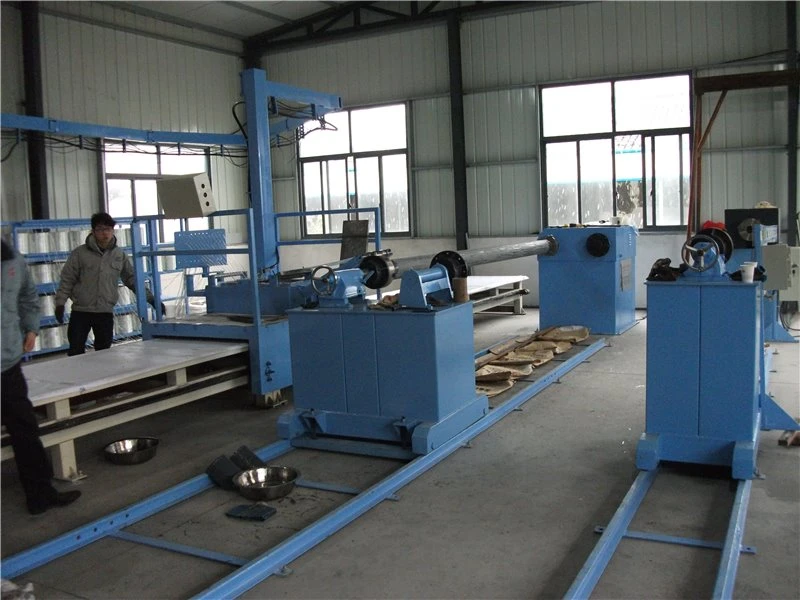
Before we dive into fiber tension, let's quickly go over what GRP/FRP pipe winding equipment does. Our GRP/FRP Pipe Winding Machine is designed to wind fibers, typically fiberglass, around a rotating mandrel. These fibers are impregnated with a resin, which then cures to form a strong, durable pipe. This process allows for the creation of pipes with excellent mechanical properties and corrosion resistance, making them suitable for a wide range of applications, from water supply to industrial use.
The Role of Fiber Tension
Fiber tension is the force applied to the fibers as they are wound around the mandrel. It plays a vital role in determining the quality and performance of the final GRP/FRP pipe. Here's how:
1. Structural Integrity
Proper fiber tension ensures that the fibers are evenly distributed around the mandrel. When the tension is consistent, the fibers are tightly packed together, creating a strong and uniform structure. This is essential for the pipe to withstand internal and external pressures. For example, in a GRP/FRP Water Supply Pipe Production Equipment, the pipes need to handle the pressure of water flow without leaking or bursting. If the fiber tension is too low, the fibers may be loose, leading to gaps in the structure. These gaps can weaken the pipe and make it more susceptible to damage. On the other hand, if the tension is too high, the fibers may break, also compromising the structural integrity of the pipe.

2. Dimensional Accuracy
Fiber tension also affects the dimensional accuracy of the GRP/FRP pipes. When the tension is well - controlled, the pipes will have consistent wall thickness and diameter. This is crucial because many applications require precise dimensions. For instance, in industrial piping systems, pipes need to fit together perfectly to ensure a leak - free connection. Our GRP/FRP Insulated Pipe Winding Machine is engineered to maintain accurate fiber tension, resulting in pipes with high dimensional accuracy.
3. Resin Impregnation
Good fiber tension helps with resin impregnation. When the fibers are under the right amount of tension, the resin can penetrate the fiber bundles more effectively. This ensures that all the fibers are fully coated with resin, which is necessary for the chemical bonding between the fibers and the resin. A well - impregnated pipe has better mechanical properties, such as higher strength and stiffness. If the fiber tension is off, the resin may not be able to reach all parts of the fiber bundles, leading to areas with poor resin - fiber bonding and reduced performance.
Effects of Incorrect Fiber Tension
Low Fiber Tension
- Weak Pipes: As mentioned earlier, low tension leads to loose fibers. This results in a pipe with lower strength and stiffness. The pipe may deform easily under pressure, and its ability to resist bending and torsion is reduced.
- Resin Pooling: Loose fibers can create spaces where the resin can pool. This uneven distribution of resin can cause local variations in the pipe's properties, such as hardness and chemical resistance.
- Poor Surface Finish: Low tension can also lead to a rough surface finish. The loose fibers may not lay flat, causing bumps and irregularities on the pipe's outer surface.
High Fiber Tension
- Fiber Breakage: Excessive tension can break the fibers. Broken fibers reduce the overall strength of the pipe because they can no longer contribute to load - bearing.
- Resin Starvation: High tension can squeeze the resin out of the fiber bundles, leading to areas with insufficient resin. This can result in dry spots in the pipe, which are weak and prone to cracking.
- Difficult Winding Process: High tension can make the winding process more difficult. It may cause the fibers to snap during winding, leading to production delays and increased waste.
Controlling Fiber Tension in Our Equipment
At our company, we've developed advanced control systems for our GRP/FRP pipe winding equipment to ensure optimal fiber tension. Our machines are equipped with sensors that continuously monitor the tension of the fibers. If the tension deviates from the set value, the system automatically adjusts the tensioning mechanism to bring it back to the desired level. This real - time monitoring and adjustment help us produce high - quality GRP/FRP pipes consistently.
We also provide training for our customers on how to set and maintain the correct fiber tension for different types of pipes and applications. This ensures that they can get the best results from our equipment and produce pipes that meet the highest quality standards.
Conclusion
In conclusion, fiber tension has a significant impact on the quality of GRP/FRP pipes produced by our GRP/FRP pipe winding equipment. It affects the structural integrity, dimensional accuracy, and resin impregnation of the pipes. Incorrect fiber tension can lead to a range of problems, from weak pipes to production difficulties. By using our advanced equipment with precise tension control systems and following our recommended operating procedures, our customers can produce high - quality GRP/FRP pipes that are suitable for a wide variety of applications.
If you're interested in purchasing our GRP/FRP pipe winding equipment or have any questions about fiber tension and pipe production, don't hesitate to get in touch. We're here to help you make the most of our technology and produce top - notch GRP/FRP pipes.
References
- "Handbook of Fiberglass and Advanced Plastics Composites" by Peter F. Bruins
- "Composite Materials: Design and Applications" by Mohammed S. J. Hashmi